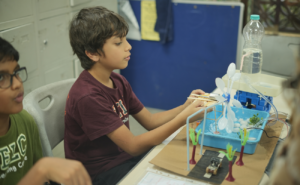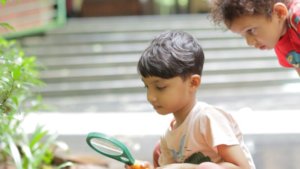
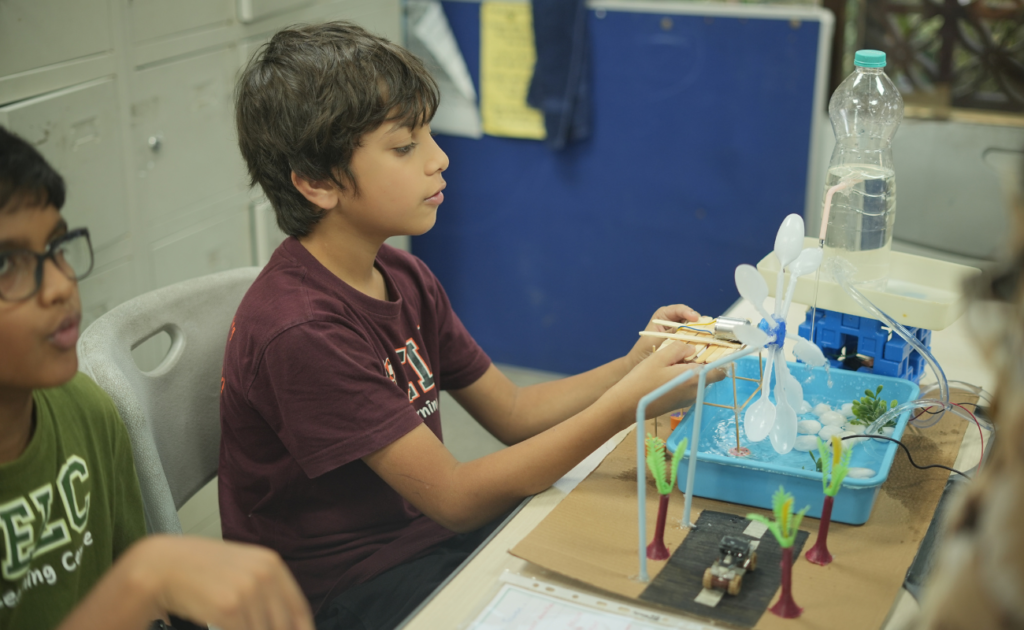
Scientific thinking in early childhood helps children understand the world through curiosity, observation, questions, exploration, and simple experiments. Young children naturally want to know how things work. They ask questions, observe changes, compare objects, and try different ways to solve problems.
These everyday experiences are the beginning of scientific learning. Children do not need complicated equipment or advanced scientific concepts to develop scientific thinking. A simple activity with water, blocks, plants, leaves, or toys can encourage them to observe, predict, explore, and explain.
Early learning environments that encourage exploration can help children become confident and active learners. For parents and educators interested in early learning approaches, ELC India provides a useful resource for understanding early childhood learning and development.
What Is Scientific Thinking in Early Childhood?
Scientific thinking in early childhood means helping children understand their surroundings by asking questions, observing carefully, making predictions, testing ideas, and discussing what they discover.
For example, imagine a child playing with a container of water. The child may wonder why one toy floats while another sinks. Instead of immediately giving the answer, an educator can ask, “What do you think will happen if we put this object in the water?”
The child can make a prediction and then test it.
This simple activity introduces important scientific habits. The child observes what happens, compares the result with the prediction, and begins to understand that ideas can be explored through evidence.
Scientific learning at this stage should be enjoyable and appropriate for children’s age. The goal is not to make young children memorize scientific definitions. The goal is to develop curiosity and a willingness to explore.
The Importance of Early Childhood Science Education
Early childhood science education gives children opportunities to learn through direct experiences. Instead of only hearing about the world, children can touch, observe, investigate, compare, and experiment with it.
For example, children can observe how plants grow, explore different textures, investigate shadows, or discover which objects move faster on a ramp. NAEYC – National Association for the Education of Young Children
These experiences can support several areas of development.
Children develop observation skills when they notice small differences. They develop communication skills when they describe what they see. They develop reasoning skills when they explain why something happened. They develop problem-solving skills when they try different solutions.
Science can therefore become connected with language, mathematics, creativity, physical development, and social learning.
How Curiosity Supports Scientific Thinking
Curiosity in early childhood is one of the strongest foundations for scientific learning. Young children naturally ask questions such as:
- Why is the sky blue?
- Where does rain come from?
- Why does ice melt?
- How do plants grow?
- Why does a ball roll?
- Why do some things float?
- Where do insects go?
Instead of treating these questions as interruptions, adults can use them as learning opportunities.
When a child asks a question, parents and educators can respond with another question. For example, instead of immediately explaining why ice melts, an adult might ask, “What do you think will happen if we leave it outside?”
This encourages the child to make a prediction and observe the result.
The child learns that questions can lead to investigation and discovery.
Scientific Inquiry for Children
Scientific inquiry for children does not need to look like a formal laboratory experiment. It can happen during play, outdoor activities, classroom discussions, or everyday household activities.
A simple inquiry process can include:
Observe → Ask → Predict → Explore → Compare → Explain
For example, children can collect different leaves during a nature walk. They can observe their colours, shapes, sizes, and textures. They can sort them into groups and discuss how they are similar or different.
Another activity could involve building a tower with blocks. Children can investigate why some towers remain standing while others fall. They can change the design and try again.
These experiences help children understand that problems can have different solutions and that testing ideas can provide useful information.
Developing Critical Thinking in Children
Critical thinking in children begins with encouraging them to think about information rather than simply accepting every answer.
When children make predictions and compare them with actual results, they begin to understand the difference between what they expected and what happened.
For example, a child may think that a large object will always sink and a small object will always float. An educator can provide several objects and allow the child to test this idea. UNICEF – Early Childhood Development
If the results are different from the prediction, the educator can ask:
“What did we notice?”
“Was our prediction correct?”
“What could we try next?”
These questions encourage children to think about evidence and reconsider their ideas.
This does not mean expecting young children to use complicated scientific reasoning. Instead, it means giving them developmentally appropriate opportunities to think, investigate, and explain.
Learning Through Simple Experiments
Simple experiments can make scientific concepts meaningful for young children.
Sink and Float
Give children several safe objects and a container of water. Ask them to predict which objects will sink and which will float.
Children can then test their predictions and discuss what happened.
Growing a Plant
Plant a seed and encourage children to observe it regularly. They can draw pictures showing how the plant changes over time.
This can introduce ideas about growth, water, sunlight, roots, leaves, and living things.
Exploring Shadows
Take children outdoors and observe shadows at different times. Ask them what they notice about the size and position of shadows.
Building with Blocks
Give children a collection of blocks and ask them to create a tall structure. If it falls, encourage them to think about how they can make it stronger.
Melting Ice
Give children ice cubes and observe what happens when they are placed in different locations. Ask children which ice cube they think will melt first and why.
These activities require very few materials but can create meaningful learning experiences.
The Role of Teachers
Teachers play an important role in developing scientific thinking. They can create classrooms where children feel comfortable asking questions and exploring ideas.
Instead of always explaining the answer, teachers can encourage children to investigate.
Useful questions include:
- “What do you notice?”
- “What do you think will happen?”
- “Why do you think that happened?”
- “How can we find out?”
- “What could we try next?”
- “Did the result match your prediction?”
Teachers can also document children’s observations through drawings, photographs, simple charts, or classroom discussions.
The emphasis should be on the learning process rather than getting every answer correct.
The Role of Parents
Scientific thinking can continue at home through ordinary activities.
Cooking can introduce measurement, temperature, mixing, and changes in materials. Gardening can encourage children to observe plants and living things. Cleaning can become an opportunity to explore which materials absorb water. Outdoor walks can encourage children to notice insects, leaves, clouds, rocks, and other natural objects.
Parents can also encourage children to explain their ideas.
If a child asks a question and the parent does not know the answer, saying, “Let’s find out together,” can turn the moment into an investigation.
Children learn that not knowing something is not a problem. It is an opportunity to discover something new.
Scientific Thinking Through Play
Play is one of the most natural ways children learn. Building, sorting, pouring, balancing, pushing, pulling, mixing, and exploring can all involve scientific thinking.
When children build a bridge with blocks, they explore balance and stability. When they play with water, they explore movement and volume. When they sort objects, they compare their characteristics.
This makes science a natural part of everyday learning rather than something that only happens during a formal lesson.
For more information about early childhood learning and development, visit ELC India.
Building a Culture of Curiosity
A strong learning environment should encourage children to ask questions without worrying about whether their ideas are correct.
Children should have opportunities to explore materials, observe nature, discuss their discoveries, and try again when something does not work.
Adults can support this culture by listening carefully to children’s questions and giving them enough time to investigate.
The purpose of scientific thinking is not simply to teach children science facts. It is to help them become curious learners who are comfortable asking questions and searching for explanations.
Why These Skills Matter for the Future
The skills developed through early scientific exploration can support learning beyond childhood.
Observation can help children notice important details. Questioning can help them seek information. Prediction can help them consider possible outcomes. Experimentation can help them test ideas. Problem-solving can help them approach challenges in different ways.
These skills can also support later learning in science, technology, engineering, mathematics, language, and other subjects.
Early experiences therefore provide an important foundation for lifelong learning.
Conclusion
Scientific thinking in early childhood begins with something very simple: curiosity.
When children ask questions, observe their surroundings, make predictions, experiment, and discuss their discoveries, they are developing important learning skills. Parents and teachers can support this process by providing hands-on activities, asking open-ended questions, and allowing children enough time to explore.
Early childhood science education does not need to be complicated. Everyday objects and experiences can become opportunities for discovery. Through scientific inquiry for children, young learners can develop curiosity, observation, reasoning, and problem-solving skills.
Most importantly, encouraging curiosity in early childhood and critical thinking in children can help create confident learners who are willing to ask questions, explore new ideas, and learn from their experiences.
For more information and resources related to early learning, visit ELC India.